How Should You Prioritise Your Website Budget?
Prioritise the work needed for your main customer action, accurate content and a maintainable website before adding optional features.
Kamil Kuś · 2024-01-23T10:06:38 · 6 minute read

Prioritise the work needed for your main customer action, accurate content and a maintainable website before adding optional features. Separate the build from software, ongoing care and later improvements. A smaller complete first phase can be sensible, but do not cut essential enquiry, checkout or access requirements merely to fit a headline price.
What should you protect when the budget is limited?
Start with what the customer must be able to do. If the purpose is to generate appropriate enquiries, the site needs understandable service information and a working enquiry route.
If the purpose is to sell products, the catalogue, payment, delivery and order-handling requirements matter. A visually polished homepage does not replace those operations.
Now distinguish three kinds of work:
| Priority | What it means | Example |
|---|---|---|
| Required for this phase | Without it, the agreed customer action or operation does not work | Enquiry delivery, checkout or necessary account permissions |
| Useful after launch | Valuable, but the first phase can operate without it | Additional case studies or an expanded resource library |
| Not yet justified | A proposed feature without a clear user need or owner | A portal nobody has defined or a complex automation nobody will maintain |
This is an original planning framework, not a ranking of every business’s needs.
How do you choose what comes first?
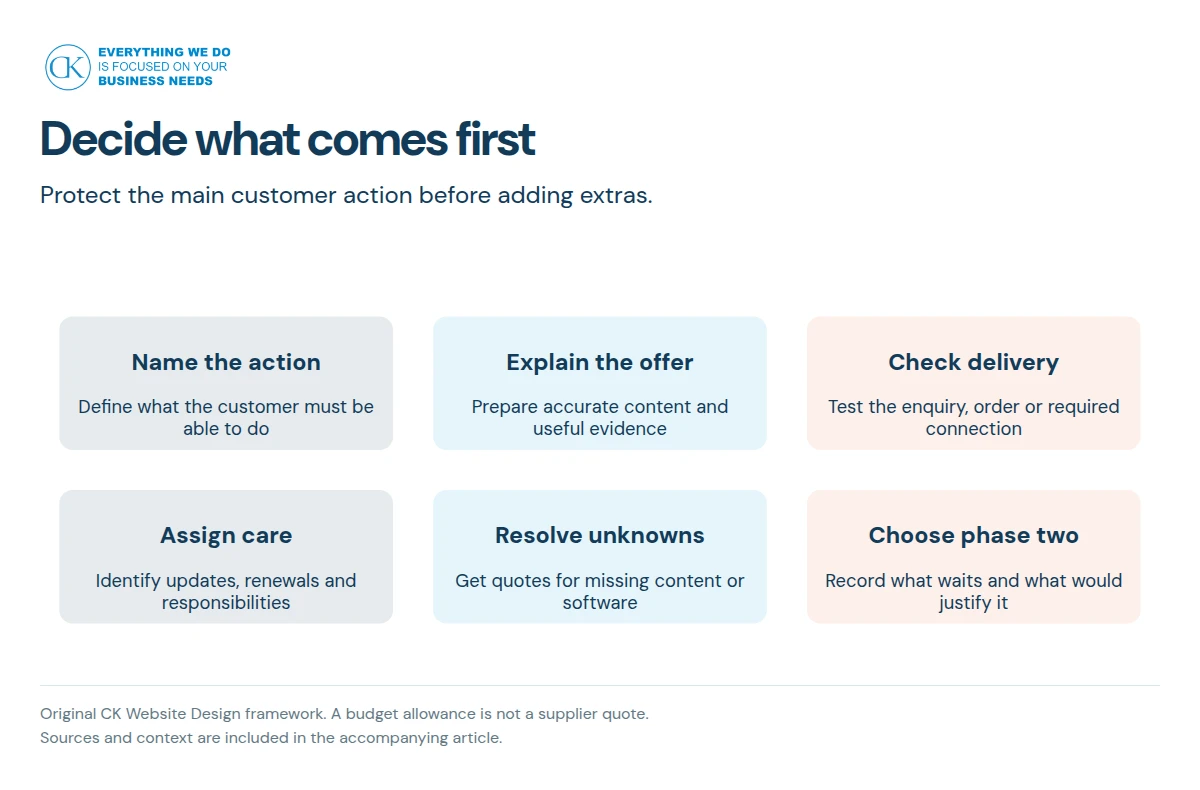
1. Name the action you need
Write it in plain English: “A customer can request a quote with the information needed to assess the job.”
If a feature does not support that action, another essential customer task or a required business operation, ask why it belongs in the first phase.
2. Make the offer understandable
Accurate descriptions, service boundaries, useful evidence and contact information should not be treated as decoration.
Google’s people-first guidance asks whether content adds original value and provides a satisfying experience. Paying for more pages does not, by itself, satisfy that requirement. [1]
3. Check the parts that can lose an enquiry or order
Test forms, payment behaviour and required connections before spending the remaining budget on extras.
For an enquiry, check the received information, the recipient and the acknowledgement. For a shop, agree the real order scenarios that need testing, including the relevant delivery and tax rules.
4. Decide who keeps it working
Identify hosting, backups, updates, software renewals and the person responsible for content. Separate those tasks from new design or functionality.
Read the care-plan scope before buying it. A maintenance plan does not automatically include unlimited changes, content writing or ongoing SEO.
5. Reserve money for identified unknowns
Examples include missing product data, photography, software licences or a connection that requires investigation.
Do not invent a universal contingency percentage. List the actual uncertainties, identify who can resolve them and obtain an allowance or quote where needed.
6. Choose the next phase deliberately
Record what is deferred, why it is deferred and what would justify adding it. “Later” should mean a defined next decision, not a hidden unfinished requirement.
What does a realistic budget discussion look like?
Consider a fictional service business with a €6,000 budget before VAT. This is a planning example, not a client story, a CK package or a promise of what any supplier will deliver.
The owner wants a straightforward custom service website. CK Website Design’s current Business Website starting point is €4,500 ex VAT. If the agreed build can fit that starting scope, €1,500 of the stated budget remains. The actual build quote may be higher. [2]
| Planning line | Amount | Important qualification |
|---|---|---|
| Business Website starting point | €4,500 | Actual written scope and quotation must confirm the build fee |
| Unallocated balance | €1,500 | Not a quoted price for SEO, photography, tracking or software |
| Stated planning budget | €6,000 | Ex VAT; not automatically enough for all first-year costs |
The useful next step is not to split the €1,500 into invented service prices. It is to ask which additional work is necessary, obtain the relevant quotes and check the running costs.
On-page SEO is optional for CK’s entry-level Business Website plan. Conversion-event setup for forms, calls and email clicks is not included. This example does not silently add either item to the starting price. [2]
The calculation is simple: €6,000 − €4,500 = €1,500. The commercial decision is more complicated because content, scope and recurring costs still need confirming.
Should you spend on traffic before improving the website?
Check the destination first. Can a suitable visitor understand the offer and complete the main action?
If the form fails, fix it. If the service information is wrong, correct it. If the site already performs its agreed tasks but few relevant people visit, the next investigation may be traffic, search visibility or promotion rather than a rebuild.
Do not assume a new design will create demand. Google’s SEO guidance explains that there is no guarantee of search inclusion or ranking. Advertising also needs its own objectives, costs and measurement. [3]
This article does not recommend a universal SEO or advertising budget.
What should you avoid cutting?
Avoid leaving the main customer action unfinished, removing essential content or losing access to the domain and website.
Treat accessibility and privacy as part of responsible project planning, not optional visual flourishes. WCAG defines practical accessibility criteria. The Irish Data Protection Commission explains that cookies and similar technologies normally require consent unless the stated strictly necessary exception applies. [4][5]
The exact legal duties and technical scope need their own assessment. A short budget checklist cannot certify compliance.
Can funding solve a budget gap?
Sometimes support may be relevant, but it must fit the business, scheme and actual expenditure.
Grow Digital does not support bespoke website development or custom software. It is not a reason to present a custom CK website as automatically half-funded. Eligible software and associated support have separate rules. [6]
Use the Irish business funding guide to find a suitable starting point. Do not include an unapproved grant as money already available.
For pricing context, read the website cost guide. For commercial boundaries, use the quote checklist.
Sources
- Google Search Central: creating helpful, reliable, people-first content.
- CK Website Design: website design services and current pricing guide. Starting point and scope boundaries checked on 9 October 2026.
- Google Search Central: SEO Starter Guide.
- W3C: WCAG 2.2 quick reference.
- Irish Data Protection Commission: cookies and tracking technologies.
- Local Enterprise Offices: Grow Digital eligibility.
Next step: Discuss a properly scoped first phase, with essential work, optional items and running costs separated.
Frequently asked questions
Is a smaller website always the cheaper choice?
Not necessarily. A small website with complicated integrations can require more work than a larger site using straightforward layouts. Reduce unnecessary complexity, not simply the page count.
What should go into the first phase?
Include the information, functions and controls needed for the agreed customer tasks. Defer features only when the first phase can operate properly without them.
Does the fictional €6,000 example include ongoing SEO?
No. It shows a budget minus CK’s current Business Website starting point. The remaining €1,500 is unallocated, not a published SEO fee or an assurance that all optional services fit.
How much should I reserve for maintenance?
Obtain a quote for the care scope your website needs. Confirm what it includes, when charges start and whether hosting or software renewals are separate. This article does not invent a universal monthly rate.
Should I pay for advertising straight after launch?
First confirm the destination, customer action and measurement you need. Then choose promotion based on the business goal and a separate agreed budget, rather than assuming every launch needs the same campaign.
Can I rely on a grant to pay the balance?
Not before the relevant body confirms eligibility, timing and eligible expenditure. Some support is advice or training, and loans must be repaid. Keep an unfunded version of the project budget.