What Should a Website Design Quote Include?
A website design quote should explain what will be delivered, who supplies the content, what the customer can do, how the site will be tested and what happens after launch.
Kamil Kuś · 2023-10-10T19:13:20 · 6 minute read

A website design quote should explain what will be delivered, who supplies the content, what the customer can do, how the site will be tested and what happens after launch. It should also separate the build fee from subscriptions, maintenance and optional work. A page count and a final price are not enough to compare proposals fairly.
Why do two similar-looking quotes cover different work?
Picture a business owner comparing two proposals for a service website. Both say “custom design, contact form and mobile-friendly pages”. This is an illustrative situation, not a CK client story.
One proposal includes a workshop, agreed layouts, content entry and a documented handover. The other expects the owner to provide finished copy, choose every image and enter the pages themselves.
Neither approach is automatically wrong. The problem is treating them as the same purchase.
Your aim is not to extract the longest feature list. It is to find the proposal that makes the division of work clear.
What needs to appear in the written scope?
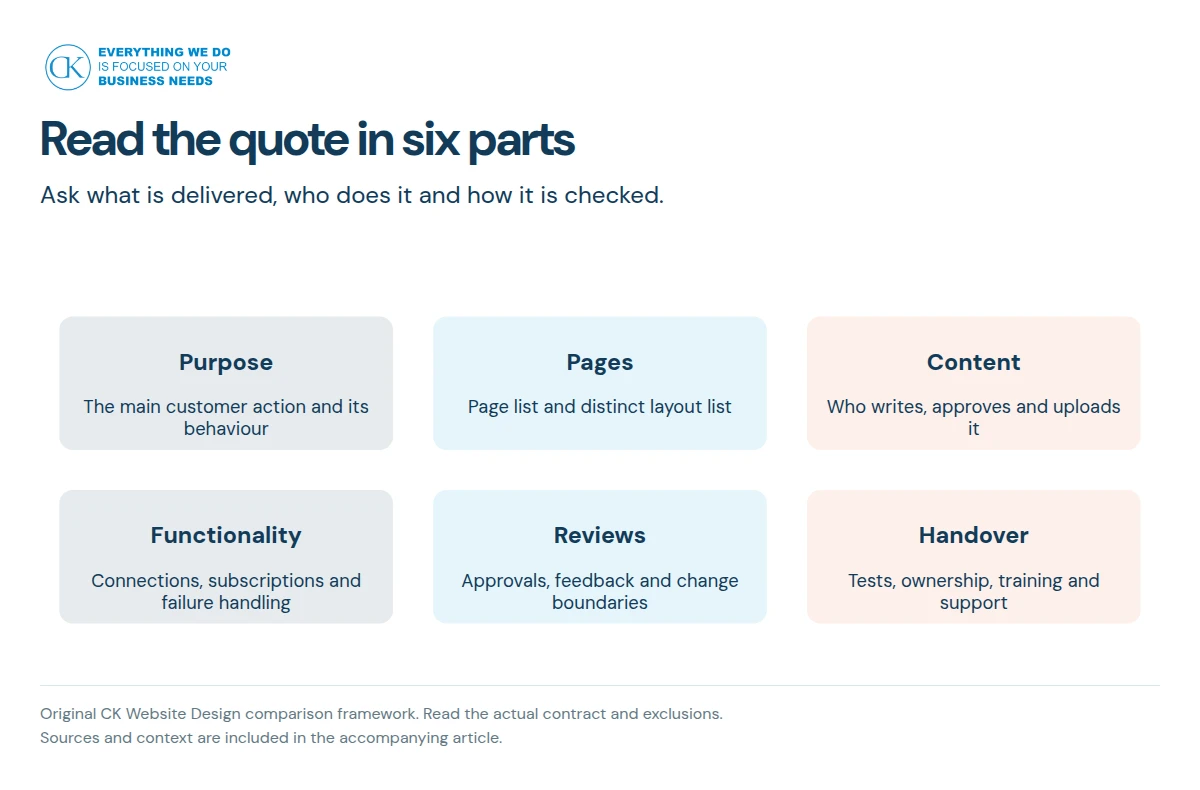
The purpose and customer journeys
The quote should name the website’s main job: receive enquiries, sell products, take bookings or support existing customers.
Ask which customer journeys are included. “An enquiry form” could mean a basic email form or a multi-step qualification process with different routing rules. Write down what the visitor submits, what they see afterwards and where the information goes.
Pages and distinct layouts
Ask for both the page list and the layout list.
For example, a homepage, service overview, individual service layout, case-study layout and contact page represent different design needs. Reusing an agreed layout for several services is different from designing every page separately.
Clarify whether legal pages, a blog, a search facility and error pages are included where they are needed.
Content and images
The proposal should state who writes, edits, approves and uploads the content.
Ask whether the price includes photography, licensed images, content migration, product data or copywriting. If images are supplied by the owner, establish who checks the right to use them.
Google’s guidance emphasises useful, reliable content for people, not content produced mainly to attract search visits. That is a good reason to budget for accurate service information rather than filling pages with generic text. [1]
Functionality and outside services
For every integration, identify the outside product, the required subscription, the account owner and the expected behaviour.
Use a simple sentence: “When a customer completes this form, the agreed fields are sent to this system, and the customer receives this acknowledgement.”
Then ask what happens if the outside system is unavailable. A visible error or recoverable submission is different from silently losing an enquiry.
Design reviews and change requests
Specify what you approve and when. Ask how many review rounds are included, how feedback is collected and what counts as a change to the agreed scope.
“Unlimited changes” is not helpful if nobody can explain the boundary. A clear process can be more useful than an open-ended promise.
Testing, launch and handover
The quote should identify the agreed checks and who approves launch.
At CK Website Design, each client receives one free hour of online training, a manual and a recording of the session. Build plans include 30 days of post-launch support; ongoing care is separate and must be scoped. [2]
Do not assume another supplier offers the same handover or support terms.
How can you make vague promises testable?
Use this original acceptance sheet during the quote conversation. It is a practical starting point, not a complete technical or compliance audit.
| Vague description | A clearer acceptance question |
|---|---|
| Mobile-friendly | Can a visitor complete the main action on an agreed phone viewport without sideways scrolling? |
| Contact form | Does a test submission reach the intended inbox with the required answers? |
| Accessible | Which WCAG criteria and testing methods are included, and what is outside scope? |
| Analytics | Which visitor reports are configured? Which conversion events, if any, are separately included? |
| SEO-ready | What technical, content and metadata work is actually included? |
| Easy to edit | Can the owner update an agreed service page during the handover session? |
| Existing content migrated | Which pages, images and metadata move, and how is missing material handled? |
WCAG provides specific criteria rather than a single “accessible” badge. A proposal should not present a few visual checks as proof of full compliance. [3]
What should the ownership section explain?
Separate four things: domain ownership, hosting access, the website’s content and the code or software used to run it.
Ask who controls the domain registration, who can create backups and what you receive if you change supplier. Check whether proprietary tools, licensed fonts, themes or plugins create continuing conditions.
“You own your website” does not explain the rights attached to every third-party component. WordPress itself is distributed under the GPL, illustrating why software licensing and ownership of bespoke work are not the same question. [4]
For an existing website, also agree what happens to useful URLs. Google recommends preparing a URL mapping for a move involving address changes. Do not leave redirects as an unpriced afterthought. [5]
Which costs should be shown separately?
Collect the build fee, required setup charges, monthly and annual software costs, hosting, domain renewals, maintenance and optional work.
Ask whether amounts include VAT and which payments are tied to milestones. Do not assume an unspecified “SEO setup” includes an ongoing campaign or conversion tracking.
The entry-level CK Business Website plan treats on-page SEO as optional and does not include conversion-event setup for forms, calls or email clicks. [2]
What can you send to a supplier today?
Copy this request and replace the bracketed details:
Please confirm the pages and distinct layouts included, who supplies and uploads the content, and how [our main enquiry or purchase action] will work. Please list required subscriptions, hosting and maintenance separately. Explain the review process, launch tests, handover, ownership and the items excluded from the quoted fee.
This is original wording you can adapt. It is not legal advice or a replacement for reading the contract.
Before sending it, prepare a one-page website brief. For the financial comparison, use the Dublin website cost guide.
Sources
- Google Search Central: creating helpful, reliable, people-first content.
- CK Website Design: website design services and current guide. Pricing boundaries, handover and 30-day support checked on 9 October 2026.
- W3C: WCAG 2.2 quick reference.
- WordPress: licensing.
- Google Search Central: site moves with URL changes.
- Google Search Central: SEO Starter Guide.
Next step: Discuss the scope you need quoted, with the customer journey and content responsibilities included.
Frequently asked questions
Is a fixed-price quote better than an estimate?
A fixed price is useful when it applies to an agreed scope. An estimate can suit work that still needs investigation. Ask what assumptions the figure relies on and how additional work is approved.
Should website copywriting be included?
It depends on the proposal. The important point is whether writing, editing, approval and upload responsibilities are stated. Do not assume “content included” means the supplier will research and write every page.
What does SEO-ready mean?
There is no single scope behind that phrase. Ask about crawlability, page titles, descriptions, content, URLs and structured data, then separate those tasks from ongoing SEO work. Google does not guarantee rankings for following its guidance. [6]
Can I ask for proof that the form works?
Yes. Include a test submission, the expected recipient, the required answers and the visible confirmation in the acceptance checks. Where integrations are involved, agree how failed delivery will be detected.
Should I control my own domain account?
Ask the supplier to document the domain registrant, administrative access and the process for changing provider. The arrangement should be clear before launch, especially if a supplier manages the account on your behalf.
Is maintenance the same as adding new features?
Not necessarily. A care plan may cover updates, backups and monitoring while new functionality requires a separate quote. Ask for included and excluded examples rather than relying on the word “support”.