AI Website Builder, Template or Custom Design: Which Fits Your Business?
Choose an AI website builder, a template or custom design by checking the customer tasks, editing needs and business systems the site must support.
Kamil Kuś · 2019-05-29T09:28:31 · 6 minute read
Choose an AI website builder, a template or custom design by checking the customer tasks, editing needs and business systems the site must support. These approaches can overlap: a custom site can use a familiar content platform, and AI can assist professional work. None guarantees better search rankings, lower total costs or stronger enquiries by itself.
Are these three separate kinds of website?
Not completely. They describe different parts of the work.
An AI-assisted builder can help generate a starting layout or draft content. A template supplies an existing design structure. Custom design tailors the website’s structure, visual design or functionality to agreed requirements.
A project might use more than one approach. For example, a business can commission a custom design on a widely used content management system. The software platform and the design process are different decisions.
WordPress’s Site Editor is one example of a platform offering controls for site layouts and styles. Its existence does not mean every WordPress project has the same level of design or functionality. [1]
Which approach suits which need?
| Approach | May suit | Questions to check |
|---|---|---|
| AI-assisted builder | A straightforward publishing need where someone can review and maintain the result | Are the content, controls, subscriptions and export options suitable? |
| Template-led website | A business whose information and journeys fit an existing layout | What can be changed without awkward workarounds? |
| Custom design | Distinctive content, customer journeys or functionality requiring deliberate tailoring | Which parts are actually bespoke, and is that work justified? |
This is a planning comparison, not a benchmark of specific vendors. Capabilities and costs depend on the product, plan, implementation and ongoing support.
What should you ask an AI-assisted builder to do?
It can be useful to explore a page structure or produce a first draft. The owner still needs to verify the business facts and review the result.
Imagine a service business generating its first site. This is an illustrative situation. The draft looks complete, but describes a service the company does not offer, invents a qualification and includes a contact method nobody monitors.
The website is not ready simply because the layout is finished. The content needs correcting, the form needs testing and the editing responsibilities need agreeing.
Google’s people-first guidance focuses on useful, reliable content. Its guidance on AI features also states that there are no additional technical requirements specifically for appearing as a supporting link in AI Overviews or AI Mode beyond the relevant search requirements. A special “AI-ready” label is not a guarantee of visibility. [2][3]
A practical review before using generated copy
- Check every service, price, location and operating hour.
- Remove invented customers, credentials and testimonials.
- Verify factual claims against named sources.
- Make the next customer action accurate and usable.
- Confirm that forms collect only the information actually needed.
- Assign someone to review future updates.
These are content and operational checks, not a claim that all AI-generated websites fail them.
When is a template a reasonable choice?
A template can be reasonable when its structure fits the information, the necessary functions are supported and the business understands the editing and subscription arrangements.
Do not dismiss a site because a template is involved. Instead, look at the finished customer journey.
The warning sign is not “uses a template”. It is repeatedly forcing the business into unsuitable layouts or adding workarounds for essential tasks.
For example, if customers need a clear comparison of several services, check whether the template can present the real distinctions. If staff need a specialised booking or approval process, check that process rather than judging the homepage alone.
When is custom design worth discussing?
Discuss custom work when the standard approach does not support important requirements cleanly.
Examples to investigate include a service structure that needs careful comparison, several distinct customer journeys, a product experience that does not fit a standard layout or connections to existing business software.
But make the bespoke work specific. “Custom” should describe agreed design or functionality, not serve as a substitute for a written scope.
Read what custom website design actually means for the questions to ask.
How should you compare ownership and ongoing costs?
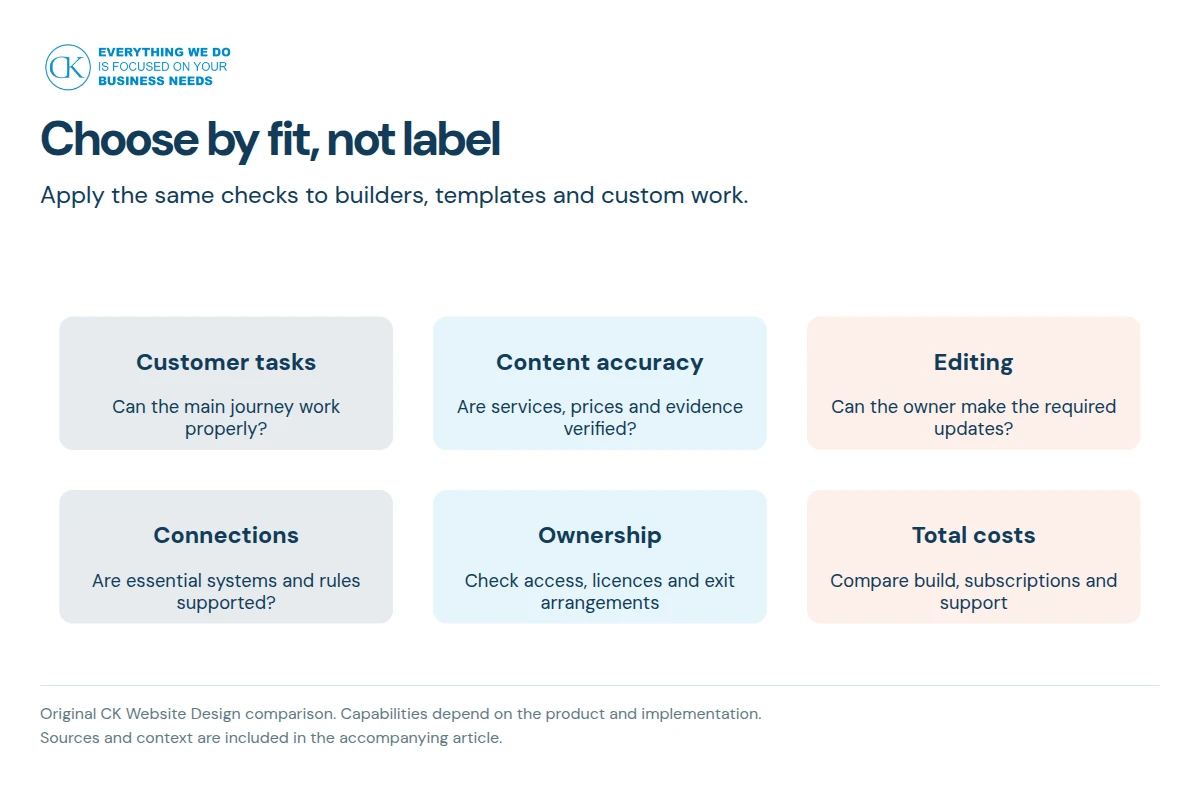
Ask the same questions for all three approaches:
| Check | What you need to establish |
|---|---|
| Domain | Who is the registered owner and who has access? |
| Content | Can you obtain the pages, images and product records? |
| Software | What licences or subscriptions remain necessary? |
| Hosting | Can the site move, and what work would that involve? |
| Editing | Which changes can you make without paid help? |
| Maintenance | Who handles updates, failures and future changes? |
Do not assume every builder prevents migration or that every custom website can move unchanged. Check the actual product terms and implementation.
WordPress’s GPL licence also demonstrates why third-party software rights should be separated from ownership of your content or commissioned work. [4]
Does custom design improve SEO automatically?
No. Search systems need access to useful content, and the website needs appropriate technical and editorial work.
Google’s SEO Starter Guide explains that there is no guarantee of inclusion or ranking. Neither a template nor a custom design removes that uncertainty. [5]
Likewise, structured data is not a substitute for accurate content. A supplier should explain the work being done, not promise that a badge, plugin or build method will secure a position in search or an AI answer.
What should you test before deciding?
Request a demonstration of your actual main journey: enquire, book, buy or access information. Then ask to update an example page.
Check the journey on a phone and with a keyboard. WCAG provides specific accessibility criteria, rather than a blanket assurance that a chosen platform makes the website accessible. [6]
Finally, compare the build and first-year running costs. A lower initial price can suit the business, but it is not the whole financial comparison.
Use the website quote checklist so that every approach is assessed against the same requirements.
Sources
Next step: Discuss the website tasks your business needs, before choosing a builder, template or custom scope.
Frequently asked questions
Is an AI website builder bad for SEO?
Not automatically. The useful questions are whether the site is crawlable, the content is accurate and valuable, and the relevant search requirements are met. The label alone does not establish its search performance. [2][5]
Does custom mean everything is coded from scratch?
Not necessarily. Custom work can use established software while tailoring the design, content controls or functionality. Ask which deliverables are bespoke rather than assuming the word defines the whole technology stack.
Can a template look professional?
Yes. The important checks are whether the implementation supports the business’s information, customer actions and editing needs. Do not treat every template-led site as poor quality.
Which option is cheapest over three years?
That depends on the build, subscriptions, support, changes and any migration work. Compare actual proposals and provider terms. This article does not present an unsourced three-year market average.
Will a custom site get more enquiries?
No build method guarantees enquiries. A project can improve agreed journeys, but demand, traffic, the offer and follow-up still matter. Agree what will be measured.
What should I do before selecting an approach?
Prepare a short brief, test the main customer journey and editing process, and compare ownership and running costs. Choose against the real requirements, not the label.