What Is Custom Website Design, and When Does Your Business Need It?
Custom website design tailors the site’s structure, visual design, content controls or functionality to an agreed business need.
Kamil Kuś · 2022-05-25T09:21:13 · 6 minute read
Custom website design tailors the site’s structure, visual design, content controls or functionality to an agreed business need. It does not necessarily mean every line of code is written from scratch. The useful question is which parts are being designed specifically for your customers and operations, and whether that work solves a real problem.
What should “custom” mean in a proposal?
It should describe something you can inspect and approve.
A proposal might include a tailored service-page structure, distinct customer journeys, carefully designed product discovery or a connection to existing business software. Those are specific deliverables.
“Unique design” on its own is not enough. Ask how the work changes the customer experience, what you will review and which parts remain standard.
WordPress’s Site Editor illustrates that an established platform can support changes to a site’s layouts and styles. The platform name does not tell you how much design work has been done for a particular project. [1]
Which parts of a website can be tailored?
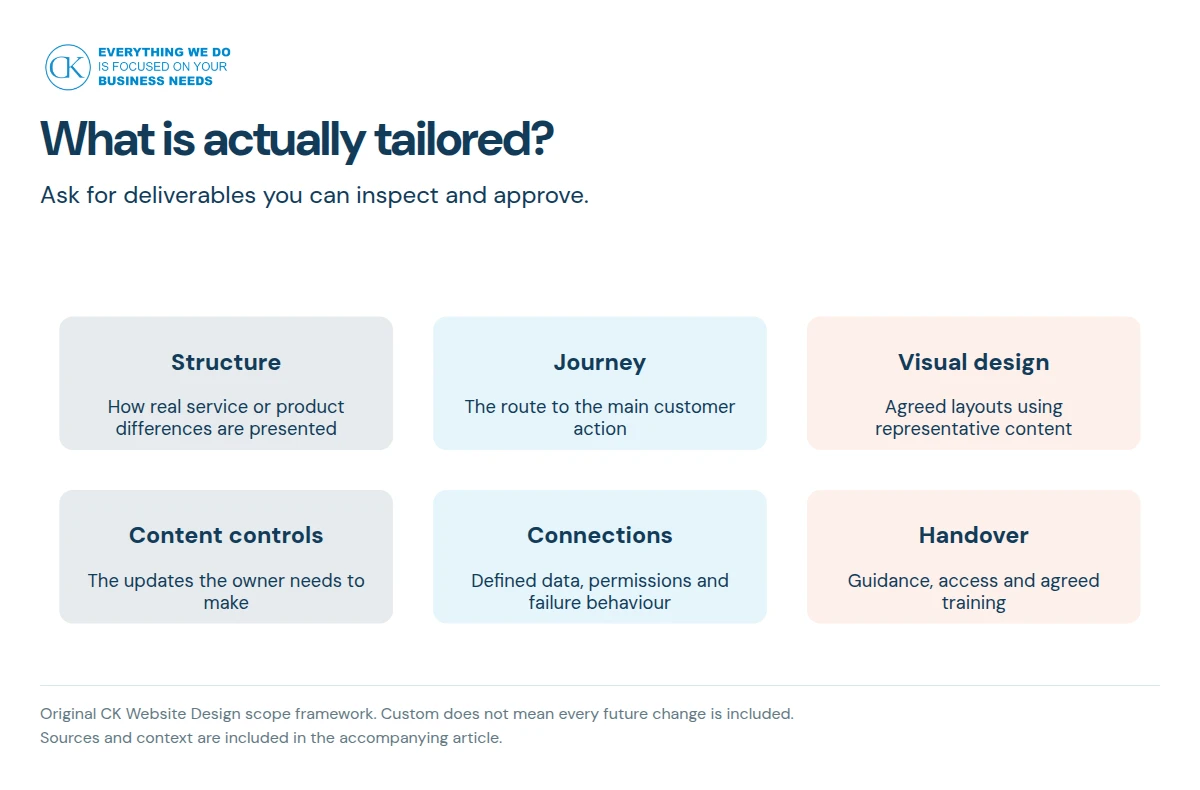
The structure of the information
The site should help visitors find the information needed for their decision.
For a service business, that might mean organising pages by the problem a customer needs solved rather than the company’s internal departments. For a shop, it could mean grouping products around how people choose them.
These are design decisions to discuss, not universal rules for every website.
The customer journey
Describe what happens from the first relevant page to the next useful action.
An illustrative service journey could be: understand the offer, check whether the job fits, see relevant evidence, then send the information needed for a quote. This is an example, not a claim about a measured conversion result.
The visual design
Layouts, typography, photography and spacing can be designed around the brand and content. The aim is not merely to look different.
Ask how the design will keep important information readable and usable on different screens. An elaborate effect is not useful if it obscures the form or makes service information hard to read.
The content controls
Agree which information you can change after launch.
Examples include service descriptions, staff details, opening hours, case studies or product records. The right controls depend on who will update the website and how often.
Functionality and connected systems
Custom work can involve bookings, payments, account permissions, document handling or connections to outside software.
Each feature needs a clear description of its behaviour and limits. If an outside system is unavailable, agree how the problem is detected and what the user sees.
The handover
You should understand how to operate the agreed controls and where to seek help.
CK Website Design gives clients one free hour of online training, a manual and the session recording. Kamil leads the project, with specialists involved where the agreed work requires them. [2]
When might a simpler approach be enough?
A straightforward website may not need custom functionality if its essential tasks are supported by existing tools and a suitable layout.
For example, a business publishing a small amount of stable information may value clear content and dependable editing more than a complex feature set.
Do not commission a portal simply because it sounds ambitious. Define who uses it, what information is private and what process it improves. If those answers are missing, the feature is not ready to scope.
The AI builder, template and custom design comparison explains the approaches without treating one as a universal winner.
How can you tell whether the bespoke work is useful?
Use this original review matrix when discussing the proposal:
| Proposed custom work | What you should be able to review |
|---|---|
| Tailored service structure | A page plan showing how real service differences are presented |
| Customer journey | A working route through the main action |
| Bespoke visual design | Agreed layouts using representative content |
| Content controls | A demonstration of the edits you need to make |
| Integration | Defined fields, permissions and success or failure behaviour |
| Handover | A usable guide, access arrangement and agreed training |
The matrix is a discussion tool, not a substitute for a detailed scope or contract.
Does custom design include SEO and measurement?
Only if the proposal says so.
Technical indexability, on-page SEO, ongoing SEO and conversion-event setup are different areas of work.
CK Website Design’s entry-level Business Website plan lists on-page SEO as an optional extra and excludes conversion-event setup for forms, calls and email clicks. Those boundaries remain relevant even when the design is custom. [2]
Google’s guidance favours useful, reliable, people-first content and clear site organisation. It does not promise better rankings simply because a website is described as bespoke. [3][4]
What about accessibility and privacy?
Include these in the conversation from the beginning.
WCAG provides criteria for accessible content and controls. The Irish Data Protection Commission explains that cookies and similar technologies normally need consent, subject to its stated strictly necessary exception. [5][6]
A custom design is not automatically accessible, privacy-compliant or exempt from legal requirements. Define the agreed work and seek the appropriate assessment where needed.
What will you own and be able to change?
Ask about the domain, hosting access, content, custom work and third-party software separately.
Then identify three types of change:
- Owner-managed: information you can update using the agreed controls.
- Supported: changes a supplier can make under a separately defined support arrangement.
- New scope: functionality or design changes requiring a new quote.
This avoids the assumption that “custom” means every future change is included.
For third-party software, check the relevant licence and subscription terms. WordPress’s GPL is one example of why software rights cannot be reduced to a single ownership sentence. [7]
How do you decide whether to commission custom work?
Prepare your main customer tasks, content needs and system requirements. Ask what can be handled with standard tools and what needs tailoring.
Then request the scope details a website quote should contain. You should be able to explain why each bespoke element is worth including.
Sources
- WordPress documentation: Site Editor.
- CK Website Design: website design services. Delivery, training, support and entry-level scope checked on 9 October 2026.
- Google Search Central: creating helpful, reliable, people-first content.
- Google Search Central: SEO Starter Guide.
- W3C: WCAG 2.2 quick reference.
- Irish Data Protection Commission: cookies and tracking technologies.
- WordPress: licensing.
Next step: Discuss the work that genuinely needs tailoring, alongside what standard tools can already handle.
Frequently asked questions
Is a custom website always built from scratch?
No. It may use established platforms and libraries while tailoring specific design, content or functionality. Ask the supplier to identify the bespoke deliverables.
Can WordPress be used for a custom website?
Yes. The platform and the design process are different decisions. The proposal should explain what is tailored and what uses standard WordPress or third-party capabilities. [1]
Will I be able to update a custom website?
That depends on the agreed content controls. Ask to see the edits you will need and include training and handover in the scope, rather than assuming every part of the design is editable.
Does custom design guarantee stronger search visibility?
No. Search visibility depends on relevant content, technical access and other factors. Google does not guarantee inclusion or ranking for following its SEO guidance. [4]
Does a custom website include ongoing support?
Check the terms. CK’s build plans include 30 days of post-launch support. Ongoing care and new development are separately scoped. [2]
What is the most useful question to ask a designer?
Ask: “Which parts of this website are being tailored to our customers or operations, and how will we review whether they work?” The answer should describe deliverables, not just a design label.